

Becoming Planetary
A Journey Through Wilderness, Presence, and Regenerative Consciousness

Becoming Planetary
A Journey Through Wilderness, Presence, and Regenerative Consciousness
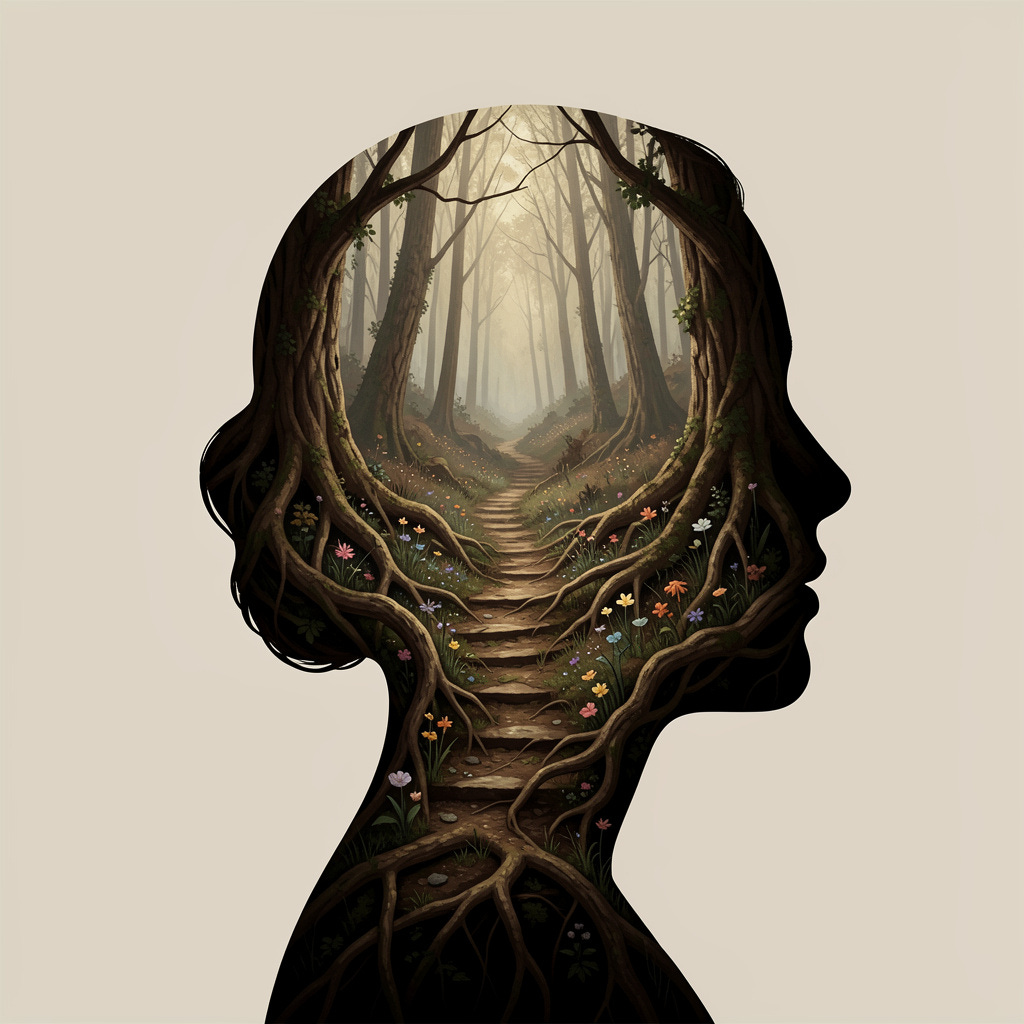
When I first stepped into the wooden house were i furthermore stayed for several years, tucked deep in the forest and out of reach of neighbours or noise, I carried with me the accumulated noise of human life: the relentless hum of cities, the subtle ache of obligations, the quiet exhaustion of carrying other people’s expectations. Then the door closed behind me, and often in the coming months, darkness fell so complete it seemed to breathe. There were no streetlights, no neighbor’s glow, no hum of civilization and in winter often the glance of the fire that warmed me. At first, I felt its weight pressing in, a presence staring unblinking. Yet in that silence, I began to awaken: to see, to hear, to feel in ways I had long forgotten. Eyes glimmered in the underbrush, a branch creaked before it fell, the wind whispered through the trees. Slowly, over nights, weeks, and years, I learned to re-see the world not as a collection of objects but as a living network of relationships, each pulse, each sound, each scent a teacher.
Which voices in your life have silenced this listening? Which rhythms hold you back from reconnecting?
The wilderness became my teacher. I learned to wait for rain and welcome the cracking of giant old trees in a storm to gather firewood, to anticipate the moon spilling silver across snow, to feel the subtle shifts in air and soil, the first pulse of spring, the hush of winter snow absorbing all sound but the steady rhythm of breath and heart. I learned to sense the smell of rain days before it fell, to notice the warmth of sun on grass long before harvest, to hear the cracking of wood before a storm, and to watch the subtle luminous arcs of eyes in the underbrush. With my horses grazing nearby and our dogs tracing invisible paths, I felt my body resonate with the life around me and i felt utterly save, as save as i never felt before not as an observer of wilderness, but as a participant. Somatic awareness—feeling with my entire being—became a doorway into a deeper understanding of life, a practice of second-tier consciousness where contradiction can exist without fracture, where modernity and nature coexist in tension and harmony.
What barriers in your body, mind, or culture prevent you from feeling fully aligned with the natural world?
Life in wilderness taught me about archetypes: the gardener, tending the pulse of life in soil and grass; the tribal keeper, preserving what is vital for community; the companion of animals, attuned to resonance and rhythm; the forest goddess, embodying wild attentiveness and patient presence. These were not symbols, but living guides, teaching patience, presence, and reverent action. The storms that once terrified became gestures of balance, the subtle warmth of moss messages of continuity, the rustle of autumn leaves a reminder of cycles.
Which inner guides or archetypes have you neglected, and which could help you restore attention and presence?
As I observed the pulse of life around me, I could feel the tension of civilization pressing against the earth: appropriation, extraction, endless expansion. Yet history offers glimpses of alternative paths. Nomadic peoples, the Aborigines of Australia, early steppe cultures—living with awareness of limits, embedded in cycles of movement and care—show that human life can flourish without domination. Even sedentary civilizations carried lessons: the transformation of agrarian China illustrates how the drive for possession reshaped human-nature relations, embedding the need for careful inner work if we are to reimagine living sustainably. Perhaps there are lessons also in Bhutan, where development is measured by happiness and ecological balance rather than mere accumulation.
Here, Deep Ecology and Arne Næss’s philosophy resonate: life has intrinsic value, human and nonhuman alike, independent of utility. The earth is not ours to dominate but to participate with, as a network of relations. Næss’s Ecosophy emerges from a profound personal encounter with mountains and communities, illustrating that attentiveness, humility, and responsibility are inseparable. This awareness is radical humility, and it carries responsibility: to act with care, to preserve abundance, to ensure the continuity of life’s richness. Yet the “Great Acceleration” of economic growth obscures these realities: material processes finite, values reduced to currency, life reduced to abstraction. In this context, the attentiveness of wilderness, the practice of presence, and the resonance of the body become acts of regeneration.
Which voices of history, society, or tradition have held you back from seeing the earth as a network of relationships, rather than a resource?
The two-sidedness of our world—the material and the experiential, the body as organism and the body as inner sensing being—comes alive in wilderness. Life is subjective, relational, and ecological at once. Love, attention, and presence become productive acts of planetary awareness.
Liminality, the threshold between dissolution and emergence, is another guide. Across cultures—Ayahuasca ceremonies, rites of passage, crop cycle celebrations—hierarchies flatten, distinctions dissolve, and authentic relationality emerges. In wilderness, I inhabit my own liminality: hierarchies of human civilization dissolve in the presence of nonhuman life, and mystical awareness is tangible. Moonlight transforms snow into midday brightness; the first rain carries messages of renewal; the fire warms not just the body but the attention. Liminality here is lived practice: listening, waiting, responding, participating without dominating.
Where in your own life are you inhabiting liminal spaces, and what emerges when hierarchy, expectation, and ego dissolve?
Life as practice and love as practice are inseparable. Love is not merely sentiment, but a principle of equilibrium between self and whole, between human and planetary life. To love is to inhabit the web of relations fully, to attune to rhythms and cycles, to engage with the world without appropriation, domination, or abstraction. Civilization often separates life from love, mechanism from subjectivity. In wilderness, this separation dissolves: attention, presence, resonance, love, and ecological responsibility converge.
To inhabit a planetary consciousness is to recognize the earth not as object but as living network, fragile and mutable, shaped by cycles, relationships, and human history. To inhabit it fully is to practice reciprocity: noticing, honoring, responding. Regeneration—both personal and ecological—is not optimization, ideology, or correction. It is resonance, attentiveness, and reverent engagement with life itself. Twenty minutes barefoot in a forest, the pulse of a river, the scent of rain, the luminous arcs of moonlight—these are regenerative acts, profound in their simplicity.
Which voices hold you back from reconnecting with this planetary network, and how might you begin listening to what has been silent?
In this attentiveness, the possibility of transformation emerges—not as doctrine, not as theory, not as ideology, but as a lived, embodied practice. The forest, grasslands, rivers, and herds become mirror, mentor, and companion. The earth pulses, and we pulse with it, learning to inhabit thresholds, cycles, and liminal spaces. We become planetary—not as abstraction, but as practice, as life, as love, as regeneration.
References and Further Reading:
Soulskin by Cordula Frei
Wild & Wunderbar by Cordula Frei
Arne Næss, Deep Ecology: Philosophy and Practice
Jennifer Gabrys, Becoming Planetary: Towards a Planetary Praxis
Victor Turner, The Ritual Process: Structure and Anti-Structure
Join our upcoming Parallax Course
Deep Ecology: Rewilding Your Soul is an invitation into regeneration as lived practice — not a conceptual environmental theory, but a return to the rhythmic intelligence of body, psyche, and more-than-human worlds. This course is designed for those who feel called to soften and reorganize the inner patterns of exhaustion, over-adaptation, and mental overdrive, and to re-inhabit life from a baseline of ecological, psychological, and somatic belonging.
Rather than a fixed short course, Rewilding Your Soul unfolds as a continuous field of inquiry over a minimum of 6 months, allowing space for deep embodiment, relational practice, and ongoing integration. The work moves through cycles of online teaching, community sharing, optional in-person immersion, and individual mentoring, creating a lived path of deep ecology — inner and outer.
Find out details: https://www.parallax-media.com/courses/deep-ecology-rewilding-the-soul