
The Screen
Are you confused, too?
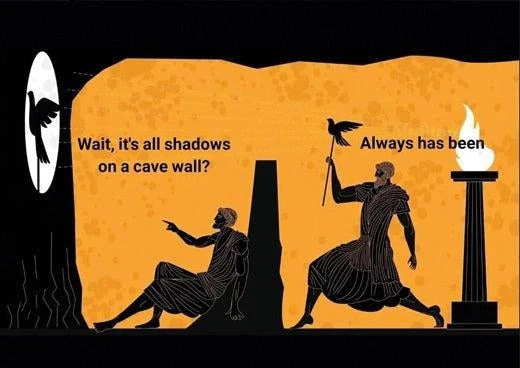
Are you confused, too, by the current state of political polarization? It hasn’t always been this way, right? Are there online “friends,” colleagues, real friends, or family members in your life who seem to live on a different planet? Do you restrain yourself from voicing your opinion because you know it will create conflict? How can someone you grew up with hold a completely different view of reality than you do? Don’t you look through the same eyes, onto the same world? Why is everybody becoming so … vicious?
People invoke the “meaning crisis” or “meta-crisis” to account for this phenomenon. Yet I think many people simply suffer from an a-historical consciousness—especially “Americans,” with their implicit insistence that the world began around 1775. I also don´t think it has something to do with the black screen in your hand, although it certainly enhances this issue at hand. I think the reason is a different screen altogether. Let me make my case.
1)The contemporary polarization between (radical) left and (radical) right in Western societies is often misread as a struggle between secular modernity and religious tradition - as a struggle of completely different worldviews (conservative/progressive), epistemes, values, and even Vmemes and cultural stages.
This schism has little to do with (for example) migration as one of the key-issues of our times, nor with the familiar pragmatic arguments about whether “the West is being colonialized” or whether “immigrants are needed as cheap labor or skilled personnel”. These claims function mostly as surface rationalizations for a much deeper moral conflict. Both sides dress their positions in economic or demographic language, but the affective intensity of the dispute cannot be explained on that level. Either it is a rational argument, or it isn´t. The arguments themselves are thin, easily dismantled, and endlessly recycled in the attention economy of TikTok, X, and similar platforms, where complex symbolic struggles are reduced to viral talking points. What is really at stake is not migration policy, but rival narratives of guilt and salvation, purity and contamination, decline and redemption. Migration becomes a symbolic screen onto which a deeper post-Christian schism projects its anxieties and hopes.
In reality, this conflict and the political polarization is better understood as an internal schism within the long secular afterlife of Christianity itself. (Post-)Modern political conflict does not take place outside the Christian moral-metaphysical inheritance but unfolds within it. Even where explicit belief in God has waned, the underlying grammar continues to structure political imagination and affective intensity. The culture war is therefore not post-Christian; it is a theological civil war conducted with secular concepts and alien-like technology.
Both extremes and sides of the political spectrum draw from the same inherited moral architecture while interpreting it in opposed directions. The (radical) left universalizes the Christian savior motif into a politics of humanitarian redemption, in which the suffering innocent becomes the moral center of history and structural guilt replaces original sin. The task of politics is framed as the rescue of victims and the moral purification of society, while dissent assumes the form of heresy and requires ritualized confession, correction, or exclusion. Abolition of hierarchy, oppression, patriarchy and colonialism all belong to the attractor-basin of left-wing politics. The left focusses on the self-sacrifice, empathy, agreeableness, self-restraint to the point of self-denial, where the dismantling and takedown of the West itself (that made this stance possible in the first place) is declared the ultimate goal – a kind of performatist contradiction in the Habermas´ian sense. Archetypically we could assume that this method of self-sacrifce and self-denial (or “love”) is more of a feminine evolutionary strategy or technique (the needs of the baby are more important than the needs of the mother), hence the accusation of the ‘feminization of culture’ by the political right.
The (radical) right, by contrast, particularizes the Christian eschatological narrative into a politics of civilizational decline and threatened salvation. Here the moral drama is staged as the fall of a once-sacred order, the corruption of tradition, and the approach of an apocalyptic crisis in which “the West” or “Christian civilization” must be defended against internal decadence and external enemies. The main narrative is that the ‘apollonian/christian’ West must be defended against the dark, chthonian, dionysian forces of brutes and nature. Archetypically we could propose that this method of rescue and imposing value (or “will”) is more of a masculine evolutionary strategy or technique (the needs of the woman and the baby needs to be protexted against a dangerous environment), hence the accusation of the ‘toxic masculinity ’ by the political left.
Both left and right positions operate with competing images of fall and redemption, corruption and renewal, even when God has disappeared from the picture. But the right operates more from the point of view of a masculine persona, to use this term from Camile Paglia, deriving it´s authority from god or evolution (or “cultural hegemony”, “scientific racism”, “IQ” – concepts re-framed and hated by the left) itself. The right, one could say, represent the evocation and invocation of ‘rights’ while the left executes and excerts it and leads by example. In a very Paglian sense, these are feminine and masculine strategies quarraling. The problem is, culture needs, in a very religious-mythic sense, “mother” as it needs “father”.
This shared theological grammar helps explain the intensity and moral absolutism of contemporary political conflict. What appears as a clash between opposites is more accurately a conflict between rival salvations, each claiming exclusive moral legitimacy. The deepest hostility arises not from radical difference, but from proximity: from competing interpretations of the same inherited moral universe.
2) Historically, this is of course nothing new. The most violent conflicts have often unfolded not between different religions, but within a single religious tradition. The Protestant Reformation was not a battle between belief and unbelief, but a war between rival interpretations of Christian salvation, fought with theological absolutism and existential stakes. The French Revolution repeated this structure in later form, staging a conflict between sacred order and revolutionary purification, complete with moral terror, heresy hunts, and promises of collective redemption. Jacobins stood for secularized Christian millenarianism, for cult of reason, virtue, purification and revolutionary salvation, while the Royalists stood sacred order, divine tradition, moral hierarchy.
The twentieth century replayed the same schism in the antagonism between Marxist universalism and fascist civilizational myth, both functioning as political theologies of fall and rebirth, purification and final salvation. In each case, the conflict did not abandon the Christian grammar of history; it radicalized it.
The ideological conflict between Marxism and Fascism in the twentieth century can be read as a secularized theological schism within the Christian moral imagination of the West. Both movements explicitly rejected Christianity as an institution, yet both inherited and repurposed its deep narrative structures: fall and redemption, chosen subjects of history, moral enemies, sacrifice, and the promise of collective salvation. What appeared as a clash between secular ideologies was, at a deeper level, a conflict between rival political theologies, each offering its own version of sin, salvation, and the end of history.
The conflict between Marxism and Fascism (today translated from the left as Marxsim vs Capitalism since Capitalism is fascist) thus mirrors a deeper Christian schism between universalist and particularist readings of salvation. Marxism radicalizes the Christian impulse toward universal redemption by extending it to all of humanity through the abolition of class and exploitation. Fascism radicalizes the Christian impulse toward sacred community by locating redemption in the restoration and purification of a particular people or civilization. Both preserve the Christian drama of fall, enemy, sacrifice, and final renewal, but they disagree violently over who is to be saved, who is to blame, and what form redemption should take. Their mutual hatred is therefore not accidental; it arises from their shared inheritance of the same moral-theological grammar, now stripped of transcendence and unleashed into the immanent arena of mass politics.
What we witness today is therefore another iteration of this long internal fracture of Western moral consciousness. Christianity did not vanish with secularization; it mutated into political moralism, into rival visions of who must be saved, who is guilty, and what kind of redemption history demands. The modern culture war is thus best understood as an intra-Christian schism in secular form: Christianity without God turning against itself in the struggle over the meaning of guilt, innocence, and salvation in a world that no longer believes, yet still longs for redemption.
3) Civil war is not, as Italian philosopher Giorgio Agamben argues, an accidental malfunction of democratic order, but one of its latent structural tendencies - its a feature, not a bug. Modern history suggests that internal armed conflict is not an exceptional breakdown but a recurring pattern. If one surveys the last two millenia, the average interval between major civil wars and large-scale internal ruptures within the geographical “West” appears to hover around the span of two to three generations, roughly seventy years. This rhythm curiously coincides with what has described as the long postwar “slumber” following the Second World War, a period of suspended systemic transformation from which Western societies are now awakening. Civil war, in this sense, is not merely an eruption of affective violence, but a symptom of accumulated unresolved contradictions within western systems that were produced by the system and not by some external factors, surfacing when inherited institutional compromises lose their binding force, or when strategies that emerges in the last circle to adress some problems do not suffice to to adress the problems thes themselves have produces. This is a ‘typical’ western problem. It appears, when the internal tension are so high that new worldviews and systems can and must emerge in order for everybody coming back together in peace. Sadly, it is inevitable to engulf us again. Not because of external factors. But because of the generator-algorhithms of western civilization itself.
Tom Amarque is writer, philosopher, podcast host, editor & publisher. His recent book is ‘Phenomenology of will’. He founded the German publishing house Phänomen-Verlag in 2009 and Parallax-Media in 2019. Tom currently lives in Palma, Spain. Contact him a tomamarque@yahoo.de
Tom, your characterization of Western culture as a kind of historical civil war has real explanatory power. I would even go further and say that much of what we call the American culture war is an intra-European or intra-“White” conflict—an argument within a shared civilizational inheritance rather than between wholly distinct cultural/ethnic worlds.
But I’m not convinced that the Western tradition is exhausted by the monotheistic arc you describe. There is another current in the West—older, plural, and probably less doctrinal—which predates and survives beneath Christianity. I call it pagan, and it represents a different spiritual and metaphysical sensibility than the one consolidated through Roman, and later Christendom, imperial economy.
This is where I part ways with the Peterson-style move which assumes any move in the Western tradition must remain within the monotheistic framework. That strikes me as historically narrow and philosophically limiting. More importantly, it is politically and economically limiting - it exists within a liberal bias. We can look towards the German Romantics and Nietzsche to find that pagan spirit wanting to show itself (and yes, it was manifest in the nationalist movement in that time).
Of course, I admit that many are likely going to be reluctant to explore the alternative European inheritances. Neither the conservatives or the progressives here in the States have interest in doing that. But if we are genuinely seeking a vantage point “above” the present conflict, as you are doing, it might require acknowledging that the West contains a more primordial spirit than Christianity. In my reading, the suppression of the spirit which lived alongside agrarian economy has lead to disaster. Not everything can be solved through the lens that f the social conflict which is “Rome vs Judea”.
This is awesome and very helpful/clarifying, thankyou