
The Wolf Moon Speaks
by Cordula Frei

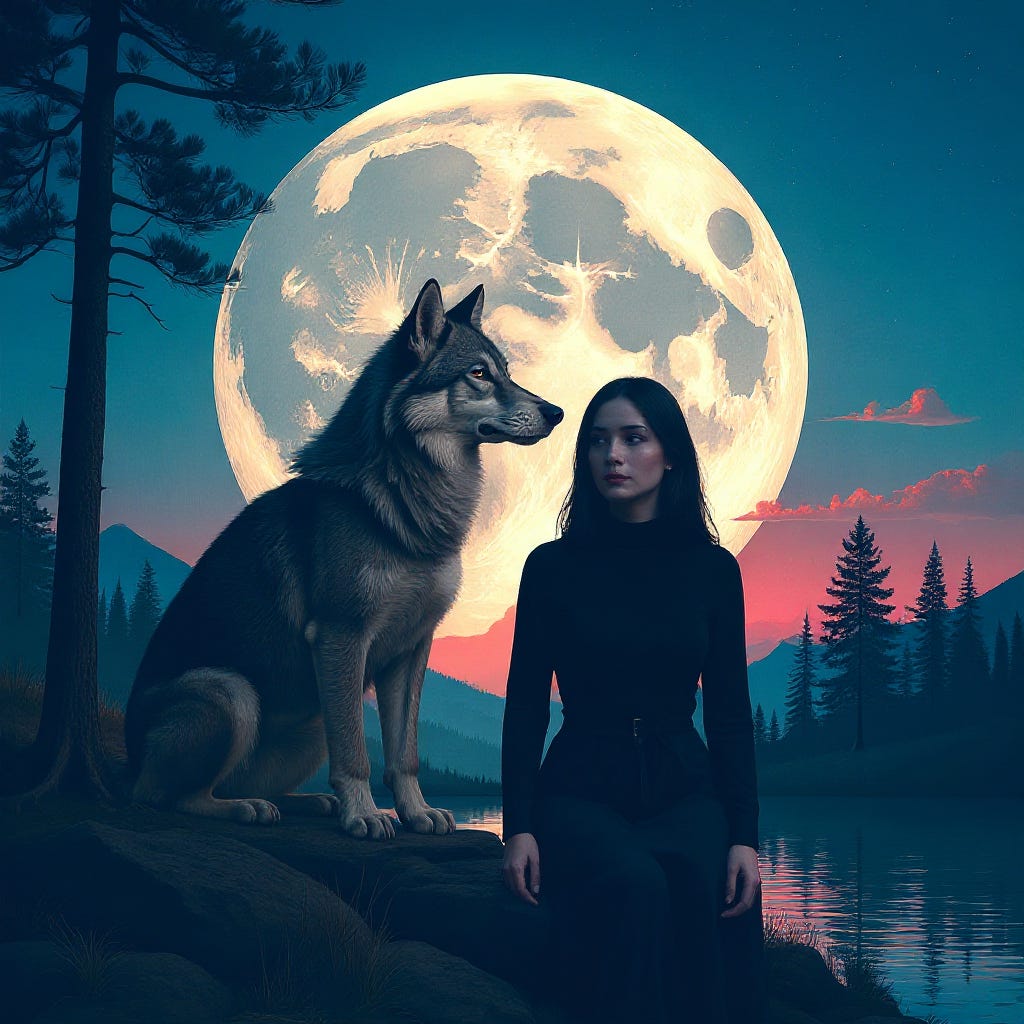
Wolf Moon in Cancer-
The Wolf Moon rises in Cancer at a time when the world feels stripped of orientation, when authority has grown loud yet hollow, when leadership has learned to dominate but forgotten how to listen, and when many bodies carry a quiet, unnamed grief that comes not only from personal loss but from living too long inside systems that ask for endurance instead of truth.
This Moon does not arrive to comfort in an easy way. It arrives to remember. It touches the limbic layers of the body where belonging, safety, and instinctive knowing reside, and it stirs what has been held there for years without language. Under this Moon, emotions are not noise; they are information, and the body becomes a landscape that speaks in sensation rather than argument.
So today, crossing borders became more than a automatic daily act. Driving toward Alsace in clear winter sunlight, the land suddenly shifted, as if another world had quietly taken over, and snow began to fall so densely that the familiar disappeared. It was not dramatic, just decisive. The road required attention. Speed changed. Perception sharpened. Suddenly from bright sunlight of the southern german, i was taken by the north-east french landscape, always just a travel of 30 minutes from home but taken in a winters fairy tale.
This is how thresholds work. They do not ask whether one is ready; they simply change the conditions and invite presence. Something similar has been happening inwardly throughout these Rauhnächte: The Twelve Holy Nights
The Rauhnächte themselves speak, these twelve nights that drift like mist between the ending and the beginning, between what has been carried and what is quietly forming.
They are neither calendar nor ritual alone, but a time when the veils thin, when the edges between inner and outer worlds soften, and the soul, like a horse sensing a distant horizon, can feel the faint stirrings of what wants to be born.
Each night asks for reflection and witness, for attention paid to the subtle movements of feeling, desire, and memory. They are a time of accounting and of grace, of noticing what has exhausted us and what has nourished us, what we have rescued and what we have allowed to teach us, and what we are finally ready to release.
In these nights between 24.12. to the 6.1. in various traditions, dreams carry messages like wind across open fields; they do not shout but illuminate the paths we did not see in the daylight.
The Rauhnächte are the time to pause between endings and beginnings, to step lightly over thresholds, to name clearly the patterns that no longer serve, and to feel the alignment of our own presence, body and mind and spirit, as it stretches into the coming year. They remind us that transition is a living process, and that even the heaviest endings can be held in a kind of sacred attention that allows the next season to arrive without rush, without strain, and with a trust that the ground is already waiting to be walked.
Walking with the horses today through the stormy icy winterland made this unmistakable. Holding the rope, moving step by step through cold air and quiet fields, it became clear how little they ask for and how precisely. They do not need intimacy, explanation, emotional effort, or reassurance. They need orientation. The moment the human body knows the path — not intellectually, but through the legs, the spine, the rhythm of walking — the horses soften and their breath deepens. If we relax, the rope loosens. They follow not because they are constrained, but because the world becomes coherent again. When doubt enters, even subtly, the herd responds immediately. Attention fragments and tension rises. The landscape is filled with imagined dangers for a horse. Leadership, in their world, is not a role but a state of inner alignment, and trust is offered not to closeness but to clarity.
This is where the Wolf Moon speaks most clearly. Opposite this lunar tenderness stands the weight of Capricorn, carrying the themes of structure, duty, hierarchy, and long-held responsibility. The tension is not between feeling and responsibility, but between responsibility carried from fear and responsibility carried from coherence.
Fear grips responsibility tightly, armors it, justifies it, exhausts itself beneath it. Clarity carries responsibility through the spine, allowing strength without rigidity and commitment without self-erasure. The Moon asks, gently but relentlessly, from where the weight has been carried all along.
Over these days, another recognition has surfaced quietly, not as a revelation but as relief: the exhaustion of always needing to save something or someone in order to be useful.
The fatigue of entering spaces where systems are broken, cultures are undernourished, power is distorted, and survival depends on invisible labor.
A new thought emerges, tentative but steady: the possibility of working where the ground is ripe and open to being prepared, where effort can become fruit rather than repair, where competence is not used to compensate for structural failure. This realization does not come with triumph, but with calm.
It surfaced, unexpectedly, in a warm café after cold hours outside, sitting with a friend and speaking honestly about work, devotion, craft, and value. Two women, deeply committed and mostly successful to what they do, suddenly seeing that the question was never whether their work was good or meaningful — that was evident in the sheer volume, continuity, and depth of what already exists — but why that value had become invisible even to themselves.
When something flows naturally, passionately, continuously, it can begin to feel like air: essential, unnoticed, unpaid. The Moon listens closely to such moments, because they reveal where fear has quietly replaced self-recognition, and where clarity now asks to step forward.
Throughout these Rauhnächte, dreams have shifted from processing the past to sketching the future.
Images of books taking form, of leadership assumed without struggle, of creative work finding its place without collapse. This is not ambition. It is orientation returning. The nervous system beginning to trust that effort and joy do not have to cancel each other out. That work can be meaningful without being martyrdom. That leadership can be firm without becoming violent.
The Wolf Moon does not demand decisions. It invites honesty. It asks where choices are still being made from fear — fear of exclusion, fear of conflict, fear of standing too clearly — and where clarity has already begun to speak through the body, quietly, steadily, without drama.
It reminds us that true leadership has always been an initiatory path, one learned not through dominance but through listening deeply enough to know where the path leads, even when weather changes, even when visibility drops.
Like the horse that follows when the human knows the way, life responds when orientation is embodied rather than explained. The Wolf walks alone not because it is abandoned, but because it is attuned. Under this Moon, the invitation is not to become louder, faster, or stronger, but to become coherent enough that others may rest, trust, and follow without force.
The Moon waits, patient and exacting, as it always does. The path does not need to be invented. It needs to be inhabited.- Cordula Frei
Cordula Frei is a weaver of worlds, a guide through thresholds of inner and outer transformation, whose life moves fluidly between landscapes, consciousness, and relational alchemy. She inhabits the forests of the Southern Black Forest and the Vosges, accompanied by her horses and dogs, and there she cultivates a life of presence, attunement, and intimate knowledge of the rhythms that sustain both human and more-than-human life.
As a writer, editor, and curator, her work has shaped integrally oriented discourse across media, bringing deep ecological awareness, somatic consciousness, and systems thinking into public conversation, while her books — including Soulskin and the forthcoming Wild & Wunderbar — offer portals into embodiment, evolution of consciousness, and the reclamation of vitality in midlife.
She teaches not merely with words, but through presence, ritual, and relational practice, bridging nervous system regulation, Voice Dialogue, ecological attunement, and lived experience, holding a space where creativity, reflection, and deep inquiry converge. In her work, she honors both the inner multiplicity of the self and the outer multiplicity of the world, cultivating a field where insight, embodied knowing, and ethical action meet.