
What is “will”? - Part six
A Cosmological Perspective (in 1000 words or less)
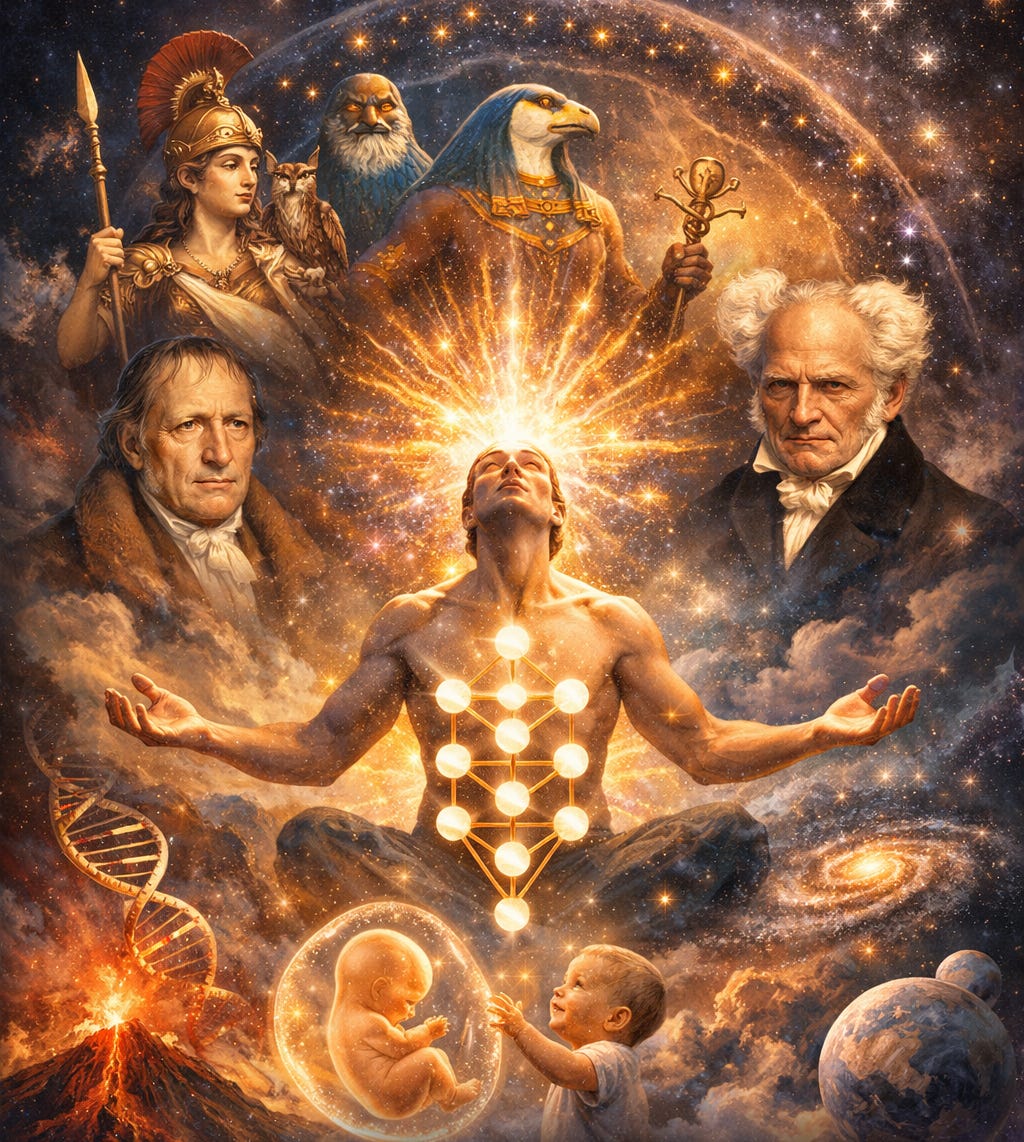
Hierarchical thinking—for example in terms of developmental stages—is familiar to us all. In the context of the will, Hegel proposes a three-layered account in the introduction to his Elements of the Philosophy of Right. There he distinguishes between the natural will (§§10–13), the arbitrary will (§§14–20), and finally the free will (§§21–24).
In my Phenomenology of Will, I used this structure as a basis for recontextualizing and further developing Hegel’s framework in contemporary terms, drawing on systems theory and developmental psychology. I described the pre-rational (instinctive) will, the rational-egoic will, and the post-rational or post-egoic will—the latter realizing its freedom by deploying and recursivly organizing its own autopoiesis.
I also attempted to integrate this model with Schopenhauer’s conception of the will, which—at least to the superficial observer—appears to stand in sharp contrast to Hegel’s account. For Schopenhauer, the will is the underlying metaphysical principle of all phenomena and of the laws of nature themselves. Freud later drew on Schopenhauer’s insights when formulating his theory of the libidinal force of the id. All things in existence come into being through what we may call “will”: a perpetually mobile process and in itself blind force in which processes generate further processes. (Erich Jantsch later—perhaps unconsciously—extended this Schopenhauer´ian line of thought in his work on the self-organizing, autopoietic dynamics of the universe, as did the physicist Lee Smolin in his evolutionary account of cosmology.)
An integration of Hegel’s and Schopenhauer’s approaches allows us to expand our understanding of the will—not merely as a uniquely human capacity, but as a universal principle. “No man is an island,” as John Donne famously wrote; we are neither separate from nor isolated within the cosmos that brought us into being. We are governed by the same underlying principles, though expressed in specifically human forms. We are not singular, self-enclosed entities but differentiated expressions of a larger whole.
If something like human will exists, there must, in some corresponding sense, be an equivalent at the level of the universe as a whole. It is precisely here that Schopenhauer’s thought becomes decisive.
The experience of creation is at least familiar to us in the most intimate way. Inception is always swift and expansive. Biological conception occurs in a brief moment—often, and ideally, accompanied by exuberant joy. Yet the consequences of this act—the raising of offspring—extend over many years and reverberate across generations, shaping the human story as long as our species endures. It is this act that sustains us.
Similarly, the fundamental laws of nature—the architecture of four-dimensional spacetime and the four basic forces of the universe—emerged within an extraordinarily brief cosmic moment. Compared to the condensed and crystallized universe we observe today, their appearance seems almost instantaneous. Yet their differentiation and expression unfold across eons. Once the gravitation emerged, it will persists practically ad infititum.
The old mystics referred to this principle of swift and expansive inception—found both in the cosmos and in the human psyche—as the building blocks of existance as Chokmah. In the Kabbalistic Tree of Life, perhaps the oldest hierarchical developmental model we possess, Chokmah is associated with “Wisdom.” From it follows the structured appearance of the universe as we know it. Yet Chokmah itself is elusive: the moment one attempts to grasp it, it has already passed. To perceive it requires reflection—but reflection occurs only below what the Kabbalists called “the Abyss,” the threshold that separates, in our terminology, the transrational from the rational.
In mythic language, Chokmah is goverend by figures or ‘gods’ such as Thoth (or Hermes/Mercury), Horus (Zeus), and Nut (Nuit). These symbolic correspondences allude to archetypcal characteristics or architectual structure and processes of the cosmos such as swiftness (Thoth), a creative and even violent surge of force (Horus), and expansive spatial openness (Nut).
The Greek goddess Athena was likewise associated with this principle, for she sprang forth “like a flash of insight” from the head of Zeus—a cognitive image of sudden, luminous emergence. She bears all insignia of war, but also of wisdom and philosophy since she is also the owl that flies in the twillight between day and night that makes philosophy and ‘inbetweenness’ possible. The Roman equivalent to Athena is Minerva, hence it was Hegel who famously wrote"The owl of Minerva takes its flight only when the shades of night are gathering.” It is most often these Athena-like flashes of insight that redirect our lives and give them new orientation. Rarely do we transform anything through endless rumination. And withing this creative flash of emergence, all forms and laws are already contained, even if it takes a while for them to manifest.
And indeed, the emergence of the laws of the cosmos—both within and around us—did occur in such a flash of luminous inception, at least according to contemporary cosmology. This in itself is extraordinary. While this primordial event defines and brings forth the laws of existence—gravity, electromagnetism, and the other fundamental forces—the deeper “source code” of emergence itself, the genesis of something from apparent nothingness in a burst of exuberant becoming, remains to this day profoundly mysterious. Or in mystics terms: One can´t explain Kether.
A post-egoic will—or, in Hegel’s terms, a free will—is capable of aligning itself with these universal principles. Creation is joy. And joy is not merely a human emotion; it is the human representation of a deeper creative impetus that permeates the cosmos itself. In this sense, joy is the proof of creation. And we might elaborate this in part seven: will is nothing else then applied autopoesis with various grades of ‘self-reflection’ or awareness or integration.
Tom Amarque is writer, philosopher, podcast host, editor & publisher. His recent book is ‘Phenomenology of will’. He founded the German publishing house Phänomen-Verlag in 2009 and Parallax-Media in 2019. Tom currently lives in Palma, Spain. Contact him a tomamarque@yahoo.de