

When the Earth Turns Dark: Notes from a Threshold
by Cordula Frei

von Cordula Frei
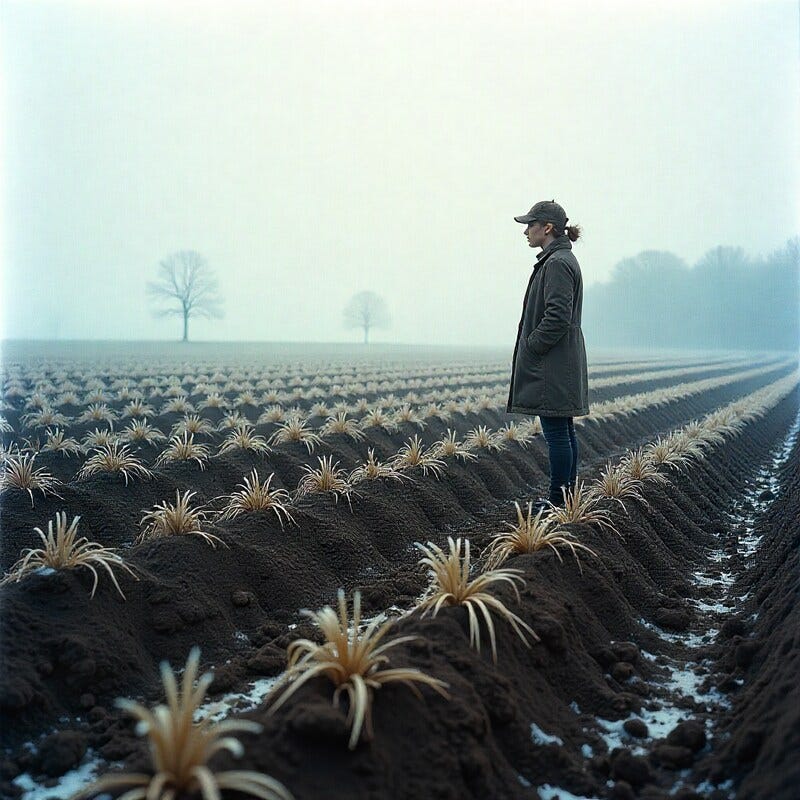
I stand at the edge of the land in Alsace. It is January and the earth is bare.
The farmer has already passed through, as he does every winter, turning the soil in preparation. What remains is naked ground—dark, raw, exposed. If I look closely, I can see tiny roots, shredded, pale threads of life torn open by steel. This gesture is so normal it barely registers as violence anymore. And yet, something in me recoils.
In summer, this same land leaned toward the sun. Corn, wheat, grasses—each growing with quiet determination, each participating in a rhythm older than memory. In autumn, harvest came. Now, walking beside my horse, my dog trailing behind us, I watch the overturned soil and wonder how many microcosms have been destroyed in this usual procedure. How many worms, fungi, bacterial networks—how many invisible collaborations—have been disturbed or killed.
This is not an accusation.
It is a question of relationship.
Permaculture teaches that soil does not regenerate through repeated disturbance. Life builds life. Fertility emerges not from exposure but from protection. Not from cutting deep, but from keeping roots intact. From mulching instead of ploughing. From cover crops instead of naked ground. From compost, mycelium, diversity, and time.
In regenerative agriculture, soil is understood as a living intelligence. It restores itself when it is fed rather than broken open—when organic matter remains on the surface, when microorganisms are allowed to complete their cycles, when the earth is trusted to do what it has always known how to do.
Standing here, I feel how familiar this landscape is to how i am feeling.
There are seasons in a woman’s life when the ground beneath her feet does not merely feel unstable, but seems to disappear entirely. Moments when the inner map dissolves and the paths that once carried her no longer reveal themselves.
For many women, the years around turning fifty are such a threshold.
Not only biological or merely hormonal but as a profound reorientation of life itself—forcing a reckoning with old structures, familiar roles, and silent adaptations once made to survive. Decisions that used to feel self-evident blur. Even the small, daily paths begin to feel strange.
The body responds differently now. The nervous system becomes more sensitive to stress and emotion. Our sleep changes, muscles hold tension less easily. Memory and attention may waver.
Is this all of this is normal, i wonder, as i walk on, watching the wide horizon and taking a deep breath of the cold winter air. I feel like in this winter mode, like the earth before me. The inner systems that once ran quietly in the background reorganize. The body asks for a different pace, a different kind of listening.
Is this disorientation a failure? It certainly feels as if the natural strength and inspirations and power to achieve what we aim for heartfully, is kind of fading.
But perhaps, - i wonder, it is a kind of initiation. I step into the trees which so mystically grow wild in alsace and are hardly disturbed by any human interaction. Almost like in fairytaleland, i am absorbed immediately by this amazing stillness. Everythind is alive. But there is quiet as if any noise is absorbed by trees, moss, soil, branches, woods.
Turning into midlife, i often feel like a forest wrapped in fog, everything feels unfamiliar. We may lose ourselves among shadows. Yet this is precisely the moment when old maps—drawn from productivity, performance, and expectation—can be laid down.
What if this life phase is not an ending, but rather a turning?
In the female brain, a quiet but profound transformation unfolds. Old pathways loosen and new connections form. Memory, emotion, and perception begin to reorganize. Feelings deepen—joy, grief, wonder, melancholy all become more vivid. The psyche grows less tolerant of what is untrue, unsustainable, or misaligned.
I hear some deers hushing away as my dog nears and branches crack. The horse looks up and then sighes at ease. Nothing to be alert about: This is not decline, it is rewilding.
Just as soil cannot regenerate when it is repeatedly torn open, the midlife body refuses endless extraction. What once worked no longer does. Energy must be redesigned. Nourishment must change.
What if this phase is not the end of fertility—but a shift in what we are fertile for?
In ecopsychology, regeneration is not a technical fix, it is relational. Joanna Macy taught that despair for the world is not pathology, but a sign of connection. Grief is not something to overcome, but something to enter.
“The heart that breaks open,” she wrote, “can contain the whole universe.”
Joanna Macy (1929–2024) devoted her life to helping people stay present in times of unraveling. A scholar of Buddhism, systems theory, and deep ecology, she understood that the crises of our time—ecological, social, psychological—are not separate. She called her work The Work That Reconnects, because at the root of our suffering lies the illusion of separation.
“We are not separate from the world,” she reminded us: “We are the world, in human form.”
Standing before this bare earth, I feel that truth in my body. The land is not broken. It is wounded. And wounds do not heal through force they heal through care.
Macy spoke of the Great Turning—the long, uncertain shift from an industrial growth society toward a life-sustaining culture. She never promised success but offered a path of participation.
“Hope,” she said, “is a verb with its sleeves rolled up.”
This threshold in a woman’s life belongs to that Great Turning too. It is a personal revolution that mirrors a planetary one. A refusal—quiet or fierce—to continue systems, internal or external, that depend on depletion.
As I walk further and the forest darkens, another presence joins me.
I often sit with her by an inner fire and meet her—I call her The Keeper. The one who carries knowledge older than words. Her skin is marked with earth and ash. Her eyes hold the glow of deep time. I met her in dreams, in imagination and in the face of many women when traveling this world.
“You did not invent me,” she says and laughs. But: “You remembered me.” It seems that she is keen of this matter.
I have learned, by listening and meeting her again and again, that she speaks from the most ancient place in the brain, where instinct, body wisdom, and survival live.
“This is your first knowledge,” she whispers. “You have seen long enough with your head alone. Now remember with your whole body.”
She is what C. G. Jung called an archetype—a primordial pattern of human experience. Not fantasy, but a living memory. She is the tribal guardian, the elder, the one who knows how to tend fire, soil, and soul.
Modern life buried her beneath productivity and noise. Her rituals replaced by schedules. Her fire dimmed by constant doing. And yet, she never left.
The wisdom was not lost but it was covered, like the earth, i was thinking to my self, which had been tossed around upside down. All the many living inhabitants of its microcosmos were left like the soil beneath its repeated turning.
There are ways back—to her, to ourselves, to the land: Perhaps through slowing down and a new form of listening and by honoring cycles rather than overriding them.
Earth regenerates when we stop extracting and start relating.
Women regenerate when we stop performing and start remembering.
Joanna Macy showed us that staying with grief, with change, with uncertainty is an act of love. When she died, she did not disappear, instead she became lineage.
Like the Keeper, her voice waits—in the soil, in the body, in the quiet place where we remember that we were never separate to begin with.
The earth rests now.
So do I.
And in this resting, something begins again.
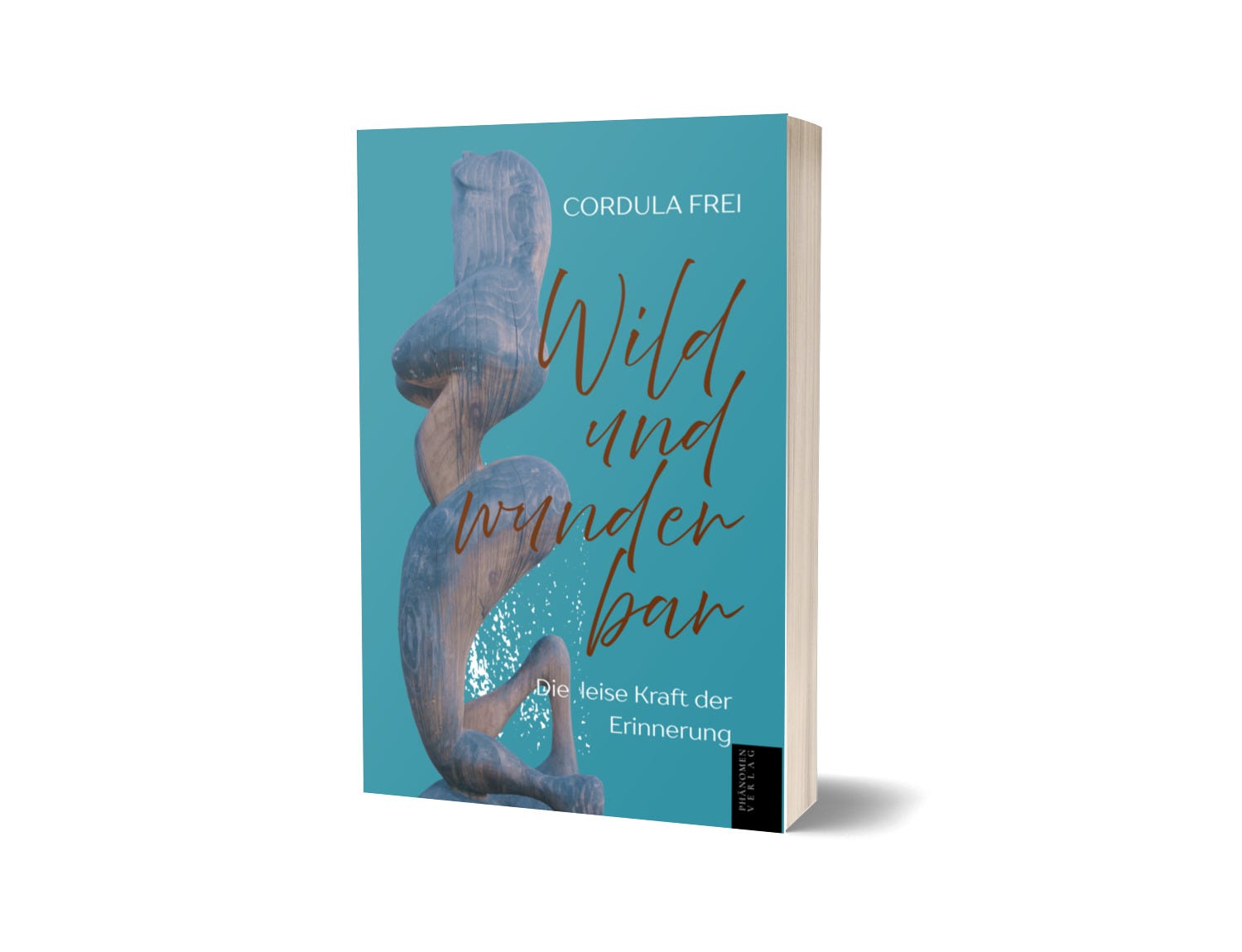
Upcoming at 16/2/2026: My new book Wild & Wunderbar
Wild & Wunderbar is a book about a threshold many women sense today—a time marked by exhaustion, inner unrest, long illness, or profound bodily change, and at the same time by a quiet knowing that something deeper wants to emerge.
Blending personal stories, nature-based experiences, yoga and breath practices, ritual work, and insights from neuroscience, stress research, and consciousness studies, Wild & Wunderbar explores how women can reconnect with an archaic, feminine intelligence—wisdom stored not in concepts, but in the body itself.
Drawing on contemporary research in neurobiology, immunology, and regeneration, the book shows how nature contact, breath, rhythmic movement, and sensory experience support neuroplasticity and nervous system regulation—especially in times when the body demands a new way of living.
Wild & Wunderbar is an invitation to women who feel tired—not from weakness, but from carrying too much for too long. A call to remember rhythm, connection, and inner authority. A book for times of transition—and for the emergence of a new feminine culture of wisdom.
🙏🙏